Table of contents
- Key takeaways
- What is professional liability insurance and how does it differ from general liability?
- When will clients, prime contractors, or contracts require E&O insurance?
- What does professional liability (E&O) typically cover — and what it doesn’t?
- How much does E&O cost for consultants — and what drives price?
- Claims‑made vs occurrence policies — which matters for consultants?
- How to buy and compare professional liability policies (step‑by‑step checklist)
- What coverage limits should a consultant buy?
- Decision checklist — should you buy E&O now?
- Frequently asked questions
- Bottom line
Consultants who give advice, produce deliverables, or sign contracts that could leave a client claiming financial loss should carry professional liability insurance (also called errors & omissions or E&O). It’s not legally required for most independent consultants, but clients or contracts often insist on it. A single claim can create heavy defense costs and settlements that personal assets or basic business insurance won’t cover. This guide explains what PLI/E&O covers, when it’s required, typical costs (per the cited sources), how to pick limits and carriers, common mistakes consultants make, a real-world scenario, a buying checklist, and practical questions to ask your agent.

Key takeaways
- If you provide professional advice, reports, designs, code, or strategic plans that a client could claim caused financial harm, you should carry professional liability (E&O) insurance. (See the Insurance Information Institute and SBA links below.) (iii.org)
- Clients, prime contractors, and government purchasers commonly require proof of professional liability; contracts may state minimum limits and additional-insured or certificate requirements. (Examples below.) (legacy.sba.gov)
- Cost varies a lot by profession, revenue, claims history, and limits: MoneyGeek’s modeled national average is about $716/year ($60/month) for a 1–4 person business (updated Sep 8, 2026); NerdWallet’s median example figures for specific consultant types are higher in some cases. Always get quotes for your facts. (moneygeek.com)
- Most PLI/E&O policies are written on a claims‑made basis (you usually must have coverage when the claim is reported). If you change jobs or retire, ask about “tail” or extended reporting period coverage. Planned H2s (each is covered below):
- What is professional liability insurance and how does it differ from general liability?
- Do consultants legally need professional liability insurance?
- When will clients or contracts require E&O insurance?
- What does professional liability (E&O) typically cover — and what it doesn’t?
- How much does E&O cost for consultants and what drives price?
- Claims-made vs occurrence: which matters for consultants?
- How to buy and compare policies (step-by-step checklist).
- Common mistakes consultants make with insurance.
- What coverage limits should a consultant buy?
- Real-world scenario and decision checklist.
What is professional liability insurance and how does it differ from general liability?
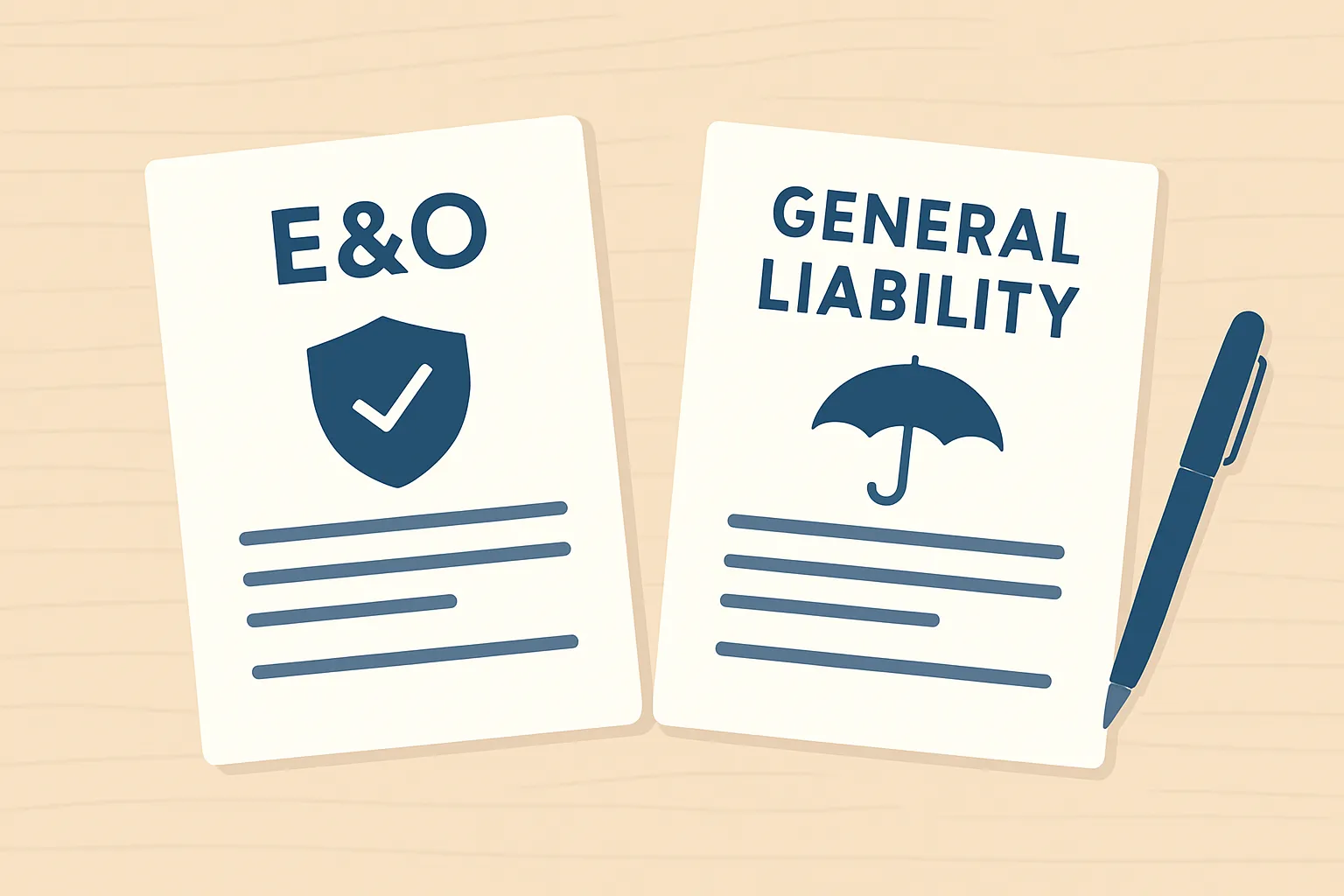
Professional liability insurance (errors & omissions or E&O in the U.S.) pays defense costs, settlements, and judgments when a client claims your professional services, advice, deliverables, or omissions caused financial loss. The Insurance Information Institute describes it as protection service providers need when their counsel or service could lead to client losses. It covers alleged financial harm, not physical injury or property damage. Commercial general liability (CGL) covers bodily injury, property damage, and some personal/advertising injuries (slips, property damage at a client site, libel or slander in some cases). A CGL won’t defend you against a client claim that faulty market analysis, buggy code, or a missed regulatory filing caused business losses—E&O responds to those scenarios. Use this table to compare at a glance.
| Coverage type | What it usually covers | Who needs it | Typical claim trigger |
|---|---|---|---|
| Professional liability / E&O | Defense costs, settlements for alleged negligence, errors, omissions, bad advice, or failed deliverables | Consultants, advisors, software developers, accountants, architects, other service professionals | Client claims lost profits or corrective costs due to your advice or deliverable |
| General liability (CGL) | Third‑party bodily injury, property damage, some advertising injuries | Any business with public interaction or client site visits | Client slips in your office, damaged property during a site visit |
| Cyber liability | Breach response, forensic, notification, some third‑party liability | Consultants handling client data, IT consultants | Data breach exposing client or customer data |
| Professional errors (technology E&O) | Technology‑specific errors like buggy software, failed integrations | Software consultants, SaaS providers | System outage caused by a configuration error |
| (Definitions above reflect standard industry usage; see the Insurance Information Institute and MoneyGeek for more coverage detail and examples.) |
Do consultants legally need professional liability insurance?
Short answer: usually no—unless your state license or specific contract requires it. For most consulting specialties (business strategy, management, marketing, IT, HR), there’s no blanket state law requiring PLI for unlicensed consultants. The SBA lists professional liability as a recommended policy for service businesses but doesn’t require it. If you work in a licensed profession (certain engineers, architects, health professionals, attorneys in some contexts), licensing boards or procurement rules can require minimum malpractice or professional liability coverage. Check your profession’s licensing authority and state procurement rules. (sba.gov) Example: state and government contracting documents often set insurance minimums for consultants hired to perform work for an agency. The SBA and state procurement guidance show $1M per occurrence / $3M aggregate or similar figures in sample solicitations. If you plan to bid on government work, read the solicitation and buy coverage that meets the contract.
When will clients, prime contractors, or contracts require E&O insurance?
Clients commonly ask for a certificate of insurance naming them as certificate holder when:
- Projects have technology or software risk where a bug could cripple operations.
- Work involves financial, tax, or compliance advice that could trigger fines.
- Government agencies and large private firms include minimums and certificate or endorsement requirements in contracts.
- Prime contractors pass risk management obligations to subcontractors. Expect requests for a Certificate of Insurance showing professional liability limits (commonly $1M/$1M or $1M/$2M), general liability proof, and sometimes cyber coverage. If you can’t meet a client’s limits, negotiate or explain risk controls—but many corporate clients won’t let work start without the requested proof. See SBA and state procurement examples for typical contract language.
What does professional liability (E&O) typically cover — and what it doesn’t?
Typical E&O coverages:
- Alleged negligent acts, errors, or omissions in your professional services.
- Defense costs, settlements, and court judgments up to policy limits.
- Claims from missed deadlines, incorrect advice, poor deliverables, or failure to perform. Common exclusions:
- Intentional wrongdoing, fraud, or criminal acts.
- Bodily injury or property damage (handled by CGL unless a specific amendment exists).
- Contractual liability where you expressly assumed liability beyond policy coverage.
- Claims from work performed while uninsured or before a retroactive date on claims‑made policies.
Ask insurers whether your routine deliverables are included in the policy’s “professional services” definition and whether cyber losses require a separate cyber policy or tech E&O endorsement. If you provide both advice and physical work, you may need multiple policies.
How much does E&O cost for consultants — and what drives price?
Premiums vary by profession, revenue, state, limits, and claims history. Two consumer research sources give benchmarks (figures reflect their cited update dates):
- NerdWallet (updated Apr 16, 2026) reports median annual premiums for consultant categories using data from Coverdash: medians include $1,800/year for business and management consulting, $1,500 for marketing consulting, and $2,800 for financial management consulting. Use these as medians, not guaranteed quotes. (nerdwallet.com)
- MoneyGeek’s modeling (updated Sep 8, 2026) estimates a national average premium of about $60/month ($716/year) for small professional services businesses (1–4 employees). MoneyGeek shows industry and state variation and explains its methodology. (MoneyGeek page: moneygeek.com) What drives your premium:
- Industry/profession risk: financial, tech, and compliance consulting typically cost more because potential client losses are larger.
- Revenue and employee count: bigger firms and higher revenue mean higher exposure. MoneyGeek models a step up when you hire your first employee.
- Coverage limits and deductible: $1M/$1M is a common base; increasing limits raises the premium.
- Claims history: prior claims usually increase future premiums and can limit available markets. Get tailored quotes. NerdWallet and MoneyGeek are useful benchmarks, but carriers price differently and professional associations sometimes offer group programs at lower rates.
Claims‑made vs occurrence policies — which matters for consultants?
Most professional liability/E&O policies are claims‑made: the policy must be in force when the claim is reported. If you move jobs, retire, or stop buying claims‑made coverage, you can lose protection for claims reported later unless you buy an extended reporting period (tail) or prior‑acts coverage. NAIC explains why claims‑made is typical for professional liability lines. (content.naic.org) Key actions:
- When switching carriers, confirm retroactive date continuity to avoid gaps.
- If you retire or stop coverage, buy a tail to cover claims that surface after you stop buying policies.
- If a client requires occurrence coverage, know those forms are rarer and often pricier for long‑tail exposures.

How to buy and compare professional liability policies (step‑by‑step checklist)
- Confirm whether you need E&O by the work you do and client contracts. Use the SBA and III definitions to decide if your services are “professional services.”
- Inventory your risks: revenue, top 3 client engagements, sample deliverables, data you handle, subcontractors you use, and whether you’ll do on‑site work. Document these for accurate quotes.
- Decide target limits: many small consultants start with $1M per claim / $1M aggregate or $1M/$2M depending on client requirements; check contracts first. (MoneyGeek models $1M/$1M as a baseline.)
- Ask about policy form: confirm claims‑made vs occurrence, retroactive date, tail cost, and whether prior‑acts coverage is included.
- Check policy definitions: what counts as “professional services”? Are subcontractor acts covered? Are third‑party financial‑loss claims included? Get exclusions in writing.
- Shop at least three carriers or programs: price varies and niche underwriters may offer better coverage for your specialty.
- Ask about bundling discounts: combining E&O with a BOP, general liability, or cyber policy often reduces total cost.
- Get a certificate and any required endorsements before signing contracts. If a client requires to be named as an additional insured or a waiver of subrogation, confirm the policy will provide it—many E&O policies don’t allow additional insured endorsements. Consult your broker on contractual endorsements.
- Keep written deliverables, change orders, and client approvals. Good documentation reduces claim risk and helps in underwriting and renewals. (Insurance Journal notes file documentation’s role in claim defense.) (insurancejournal.com) For a focused cost discussion, see the post on how much E&O insurance costs for consultants.
Common mistakes consultants make with their insurance
- Assuming general liability covers professional mistakes. It doesn’t—CGL protects against bodily injury and property damage, not negligent professional advice.
- Not checking policy wording for “professional services” or subcontractor coverage—some policies narrowly define covered services. Ask for the insuring agreement to be shown to you or your broker.
- Letting coverage lapse or switching carriers without confirming retroactive/prior‑acts continuity; a claim reported after a lapse can be denied. NAIC and III discuss claims‑made timing. (content.naic.org)
- Signing contracts that require unlimited indemnity or high limits without negotiating reciprocal protections or confirming insurance will respond. If a client asks for unreasonable indemnity, consult legal counsel and your agent.
- Relying only on low limits to save money when your project exposure warrants higher limits—underinsuring can leave you paying the remainder. MoneyGeek modeling shows how limits affect cost and recommended baselines.
What coverage limits should a consultant buy?
Limits should match your exposure and contractual requirements. Practical starting points:
- Solo consultants working with small local businesses and low contract values: many start with $1,000,000 per claim / $1,000,000 aggregate. MoneyGeek and industry benchmarks use $1M as a common baseline.
- Consultants working with larger corporate clients or in high‑risk fields (finance, compliance, enterprise IT): consider $1M/$2M or $2M/$4M and confirm client requirements in writing. NerdWallet’s medians for some categories are higher, reflecting greater exposure.
- If a client contract requires more, buy higher limits or negotiate subcontracting terms. Government or prime contracts often specify minimums—follow the solicitation. Balance higher limits against premium cost. If budget is tight, consider a higher deductible to control premium while keeping per‑claim limits reasonable. Ask your broker to model multiple limit/deductible combinations.
Real-world scenario: deciding whether to buy E&O for a solo marketing consultant
Say a one‑person marketing consultancy earns $120,000/year. The consultant writes campaign plans, manages vendor selection, and sometimes implements tracking tags. A client asks for a COI showing professional liability of $1M/$1M. What now? Step 1 — Check exposure: the work affects client marketing spend and tracking. A broken tracking tag or bad media plan could cause measurable lost revenue or wasted ad spend. That’s measurable financial exposure. Step 2 — Check contract: the client explicitly requires $1M; to take the work you’ll need to meet it or negotiate. Government and many enterprise buyers won’t accept lower limits. Step 3 — Seek quotes: MoneyGeek and NerdWallet benchmarks suggest small consultants often pay a few hundred to a few thousand dollars per year depending on industry and limits—get tailored quotes (MoneyGeek’s modeled average for 1–4 people is ~$716/year). Step 4 — Consider risk transfer: if the premium for $1M limits is unaffordable, negotiate for a lower limit plus a clause allocating liability for specific deliverables, or shift certain implementation tasks back to the client under a signed change order. Step 5 — If you accept, buy a claims‑made E&O with the requested limits, get the COI before starting, and preserve documentation for all deliverables (scope, approvals, acceptance). If you later change providers or retire, buy tail/extended reporting.
Decision checklist — should you buy E&O now?
- Do clients ever ask for a Certificate of Insurance that includes professional liability? — If yes, buy it.
- Does your work, if done incorrectly, create measurable client financial loss (lost revenue, fines, penalties, system downtime)? — If yes, buy it.
- Do you handle client data, write code, prepare financial or regulatory deliverables, or run campaigns that spend client funds? — If yes, at least request quotes for tech E&O or cyber endorsements.
- Are you bidding on government or prime‑contract work that lists minimum limits? — Buy as required by the solicitation.
Questions to ask your agent (use this at quote time)
- Is this policy claims‑made or occurrence? What is the retroactive date? Will my prior acts be covered? What is the cost for a tail/extended reporting period?
- Exactly how does this policy define “professional services”? Are my routine deliverables inside that definition?
- Will you provide the endorsements my clients require (certificate, additional insured, waiver of subrogation)? If not, what alternatives exist?
- If I change carriers, how do I maintain continuity of coverage for prior acts? What paperwork proves retroactive date continuity?
- How will a past claim affect my premium at renewal, and what loss‑control steps lower my renewal rate? Ask for concrete examples.
Frequently asked questions
Do clients always require E&O insurance?
No. Many small private clients don’t require it, but corporate clients, primes, and government buyers commonly do. If you plan to work with larger firms or bid on contracts, expect certificate requests and minimum limits. (See the SBA procurement examples.)
Is general liability enough for a consultant?
No. General liability protects against physical injury and property damage; it won’t cover alleged professional mistakes that cause financial loss. You usually need both CGL and E&O for complete protection.
If I never had a claim, can I skip E&O to save money?
Skipping E&O is a risk decision. Defending or settling even a meritless claim can be costly—E&O covers defense fees that otherwise come out of pocket. Benchmarks show affordable options exist for many consultants, but evaluate based on exposure and client expectations. MoneyGeek and NerdWallet offer cost snapshots.
What if a claim relates to both advice and physical damage?
Claims can involve multiple policies (E&O for the advice, CGL for physical damage). Insurers determine allocation; having both policies avoids coverage gaps. Your agent should help structure primary and excess placements to reduce finger‑pointing.
Are freelancers treated differently than companies when buying E&O?
Underwriting looks at revenue, services, and risk, not corporate form alone. A sole proprietor with $100K revenue may pay less than a $5M consulting firm. However, sole proprietors are personally on the hook for uninsured suits—insurance protects personal assets. MoneyGeek models costs by employee count and revenue bands.
Bottom line
If your consulting work can cause measurable client loss, carry professional liability (E&O). It’s commonly required by clients and shields you from defense and settlement costs a general liability policy won’t cover. Start by checking contract language and getting at least three quotes (use $1M per claim as a common baseline for small projects), confirm claims‑made timing and retroactive dates, and ask your agent about tail coverage and endorsements required by clients. For a focused cost breakdown, read how much E&O insurance costs for consultants and bring the documentation below to your agent: Concrete next steps (do these this week):
- Pull current or draft client contracts and note any insurance or indemnity language.
- Inventory revenue, top 3 engagements, and data you handle.
- Request three written E&O quotes (baseline $1M/$1M) and ask each carrier about retroactive/prior‑acts and tail options. (See MoneyGeek and NerdWallet links above for benchmarks.) External sources referenced (examples you can visit):
- Insurance Information Institute — Professional liability insurance overview: iii.org.
- Small Business Administration — business insurance and professional liability guidance: sba.gov.
- NAIC consumer pages — small business insurance & claims‑made explanations: content.naic.org.
- NerdWallet — Do consultants need professional liability insurance? (cost medians): nerdwallet.com. (Updated Apr 16, 2026).
- MoneyGeek — E&O cost modeling and averages (Updated Sep 8, 2026): moneygeek.com.
- Example government procurement language and insurance minimums (SBA/state procurement files): legacy.sba.gov (sample solicitation requiring professional liability).
- Insurance Journal — industry examples and E&O claim discussions: insurancejournal.com. Questions or want a draft email/certificate language to send a client (or a one‑page insurance checklist to hand an agent)? Say your consulting field, annual revenue, and whether clients already ask for a COI. Do IT Consultants Need Cyber Liability Insurance? Quick Guide, General Liability vs Professional Liability for Consultants and What insurance do independent consultants need in Texas.
Sources
- iii.orgiii.org
- legacy.sba.govlegacy.sba.gov
- moneygeek.commoneygeek.com
- sba.govsba.gov
- nerdwallet.comnerdwallet.com
- content.naic.orgcontent.naic.org
- insurancejournal.cominsurancejournal.com
- content.naic.orgcontent.naic.org
- iii.orgiii.org

Stephanie Mitchell has 20 years of experience researching and explaining business insurance topics for small business owners. About the author · Editorial standards