Table of contents
- Key takeaways
- What is equipment and tools insurance for contractors and how does inland marine work?
- What coverage options are available for contractors’ tools and equipment?
- How much does tools and equipment insurance cost and what affects the price?
- Do states or client contracts require tools and equipment insurance?
- How to buy and compare equipment and tools insurance?
- Common mistakes contractors make with tools insurance?
- Decision checklist: should you buy a standalone tools policy or an endorsement?
- How to document, prevent losses and speed claims
- Frequently asked questions
- Bottom line
Equipment and tools insurance for contractors is the policy or endorsement that pays to repair or replace the tools, portable equipment, and certain jobsite materials you use when they're lost, stolen, or damaged—usually via an inland marine (tools & equipment floater) or a scheduled equipment endorsement to commercial property or a BOP. This article covers coverage options, claim triggers, pricing drivers, state and contract requirements, how to buy and compare quotes, a decision checklist, a contractor scenario, and the questions to ask your agent.
Key takeaways
- "Equipment and tools" coverage commonly sits on an inland marine (contractor’s equipment) policy or an endorsement to a property/BOP; NAIC classifies inland marine to cover movable property and items in transit. (content.naic.org)
- Many contractor packages exclude theft from an unattended vehicle or limit per-item replacement unless you add tools coverage; NerdWallet lists inland marine (tools coverage) as a standard contractor need. (nerdwallet.com)
- Expect small tools & equipment coverage to run materially less than major coverages; MoneyGeek’s October 15, 2026 benchmark lists a tools & equipment estimate of about $42/month ($502/yr) for a 1–4 person contractor profile. (moneygeek.com)
- What you need depends on how you transport and store gear, whether contracts demand scheduled items or additional-insured wording, and state licensing rules (example: Texas trade licenses set minimum liability requirements). (tdlr.texas.gov)
Planned H2s (topics covered): What is it and how inland marine works?; Which coverage options exist?; How much does it cost and what affects price?; Are tools insurance and limits required by state or contract?; How to buy and compare tools coverage?; Common mistakes contractors make?; Frequently asked questions; Bottom line.
What is equipment and tools insurance for contractors and how does inland marine work?
Equipment and tools insurance covers portable gear, power tools, rented equipment, and sometimes materials that move between job sites, storage, and your vehicle. Insurers usually write it under "inland marine" (contractor’s equipment floater) because inland marine covers movable property in transit or stored off-premises. NAIC’s inland marine definition specifically lists movable construction equipment and items that frequent different locations.
Two technical points to keep in mind:
- Unscheduled vs scheduled coverage: Unscheduled (blanket) covers any covered tool up to a policy sublimit. Scheduled coverage lists high-value items individually with agreed limits and valuations.
- Valuation basis: Policies use Actual Cash Value (ACV), Replacement Cost, or “Agreed Value” wording — scheduled items are more likely to get agreed-value treatment.
Plain example: if a crew van is broken into and several cordless tool kits are stolen, a contractor’s equipment/inland marine policy would respond where a standard commercial property or homeowner’s policy often won’t. NerdWallet advises inland marine when tools move between sites or are routinely in vehicles.
What coverage options are available for contractors’ tools and equipment?
You’ll commonly see these product choices and endorsements:
- Inland marine / Contractor’s equipment floater — primary product for tools in transit, at work sites and in vehicles. (Usually sold as an Allied Lines/Inland Marine policy.)
- Tools & equipment endorsement to commercial property or Business Owners Policy (BOP) — convenient if you already carry a BOP and your insurer offers a floater endorsement.
- Scheduled equipment coverage — list high-value items (truck-mounted compressors, concrete saws, air compressors) with agreed values to avoid ACV depreciation.
- Rented equipment coverage — pays for loss or physical damage to equipment you rent from others (sometimes included under inland marine).
- Installation floaters / builders’ risk floaters — covers materials and equipment while being installed or awaiting installation (useful for specialized trade work).
- Crime, theft or burglary endorsements — if theft from vehicles or trailers is a frequent loss exposure where you work, check whether the floater covers theft from an unattended vehicle or requires specific vehicle security measures. (Policies vary.)
Comparison table: what each option covers, who needs it, and the common trigger.
| Coverage type | What it covers | Who typically needs it | Typical claim trigger |
|---|---|---|---|
| Inland marine / contractor’s equipment floater | Portable tools, small equipment, some owned heavy equipment while in transit/storage | Most field contractors who store tools in vehicles or move gear between jobs | Theft from vehicle, jobsite vandalism, drop/damage during transit |
| Scheduled equipment endorsement | Individually-listed expensive items with agreed limits | Contractors with high-value single items (e.g., $10k+ compressors) | Damage or total loss of a scheduled item; agreed-value payout |
| Tools endorsement to BOP | Portable tools up to a sublimit inside a broader package policy | Small contractors who prefer one policy rather than stand-alone inland marine | Same as inland marine but subject to BOP terms and sublimits |
| Installation / builders’ risk floater | Materials and equipment destined for permanent installation | Contractors installing equipment or materials on client sites | Theft before installation; damage to materials while staged |
| Rented equipment coverage | Physical damage to rented equipment | Contractors who rent heavy or specialty machines frequently | Damage to rented equipment during use |
(See our deeper notes below on exclusions and endorsements you should request.)
How much does tools and equipment insurance cost and what affects the price?
Short answer: pricing varies a lot by trade, employee count, the value you insure, claim history and location — but national benchmarks help. MoneyGeek’s modeling (updated Oct. 15, 2026) shows a tools & equipment benchmark of about $42/month ($502/year) for a one-to-four-person contractor profile; use that as a starting point, not a guaranteed quote. (moneygeek.com)
Major cost drivers
- Total insured value and scheduling: higher limits and scheduled/insured agreed values increase premium. Scheduling costs more per item but avoids depreciation disputes.
- Theft and loss environment: urban areas and sites with frequent tools theft push rates up. Underwriters watch ZIP-code-level crime and past losses.
- Storage and vehicle security: insurers give better rates when contractors lock tools in secured containers, use vehicle alarms, or remove tools from unattended vehicles overnight. Ask insurers what lowers premiums.
- Type of equipment: small hand tools are cheaper to insure per dollar than heavy, specialized machinery. Scheduled heavy equipment carries higher per-item premiums.
- Claims history and business size: businesses with prior equipment/theft claims or more employees will pay more.
If you need a ballpark for planning: MoneyGeek’s $42/mo ($502/yr) figure is for small contractor profiles as of Oct. 15, 2026; NerdWallet lists inland marine as a common need but emphasizes getting multiple quotes because quotes vary by insurer and risk profile.
Do states or client contracts require tools and equipment insurance?
Short answer: states rarely force a tools floater specifically, but licensing and contracting rules often require general liability, workers’ compensation, or certificates of insurance — and clients or primes may demand specific limits, scheduled items, or additional insured endorsements.
- State licensing examples: some Texas trade licenses require minimum commercial general liability limits for the license to remain valid; those pages also explain acceptable proof-of-insurance forms and COI procedures. The Texas Department of Licensing & Regulation lists explicit minimum liability figures for certain trades. That influences what clients will accept and whether you’ll need extra endorsements to satisfy a contract.
- Contractual requirements: clients and prime contractors commonly ask to be listed as additional insureds on liability policies and may insist on scheduled equipment for expensive items. Certificates of insurance prove coverage but don’t change policy wording; request endorsements to grant the contract party the protection they want. NerdWallet urges contractors to match contract language exactly when ordering endorsements.
If you work across state lines or bid public projects, collect the insurance requirements in writing before bidding. See our piece on contractor insurance requirements in Texas for a state-specific example.
How to buy and compare equipment and tools insurance?
Answer first: collect an inventory, decide which items to schedule, and ask for quotes that use identical limits and deductibles so you can compare apples to apples. The Small Business Administration recommends matching insurance to actual business assets and shopping multiple licensed agents. (sba.gov)
Step-by-step buying checklist
- Make an equipment inventory. Include make/model/serial number, purchase date and replacement cost. Schedule items above your planned blanket sublimit (common per-item threshold is $1,000–$2,000 but varies by insurer).
- Decide valuation type (Replacement Cost vs ACV) and which items to schedule (high-dollar compressors, laser levels, etc.). Scheduled items avoid depreciation disputes.
- Get at least three written quotes using the same coverage list, limits and deductible. MoneyGeek recommends comparing quotes apples-to-apples and modeling quotes around your actual trade and employee count.
- Ask for endorsements your clients require (additional insured, waiver of subrogation, primary and noncontributory language) and confirm whether the floater extends to tools in an employee’s personal vehicle if you allow that.
- Check exclusions: common ones are wear-and-tear, theft from an unattended unlocked vehicle, and mechanical breakdown unless rented-equipment coverage or specific equipment breakdown is added.
- Confirm claims handling: how do they value scheduled items and how fast do they issue emergency funds to keep you working?
- Keep COIs current and automate COI tracking — MoneyGeek warns that expired COIs are a frequent contract compliance failure.
Our guides on do subcontractors need their own insurance and inland marine vs commercial property for landscapers show how coverage gaps appear in subcontractor and landscaping work. Also see general cost context in how much general contractor insurance costs.
Common mistakes contractors make with tools insurance?
- Assuming general liability or auto covers tools in a truck. They usually don't — inland marine or a tools floater is the right fit.
- Not scheduling high-value items and then getting an ACV payout that won’t replace the tool at current retail prices.
- Accepting a COI without verifying required endorsements (additional insured or waiver of subrogation) — a COI proves coverage but doesn’t add insureds. MoneyGeek emphasizes sending exact contract wording to the insurer for correct endorsements.
- Overlooking per-item or aggregate sublimits in an “unscheduled” blanket — if you own many $1,000 tools, a $5,000 unscheduled limit will be insufficient.
- Failing to document serial numbers and receipts; that slows claims or undermines valuation.
Practical hypothetical: say you’re a two-person roofing crew. You keep three $1,200 cordless tool kits and one $9,000 nailer/air system in the work van. If your policy has an unscheduled tools limit of $5,000 and ACV valuation, a single theft could leave you underinsured — schedule the $9,000 unit and raise the blanket limit or select replacement-cost valuation for the rest.
Decision checklist: should you buy a standalone tools policy or an endorsement?
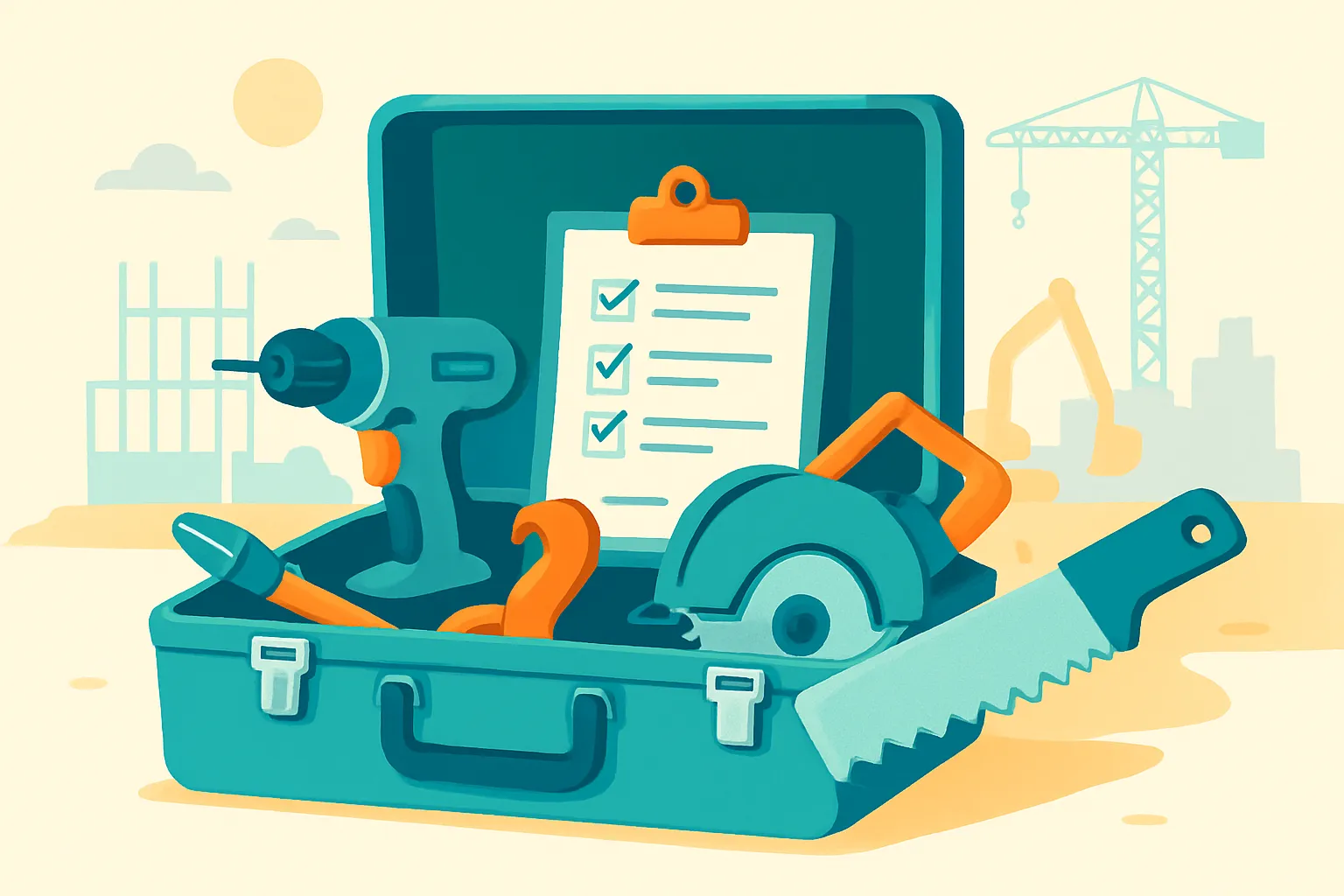
Use this checklist:
- Do you regularly transport tools in vehicles or between sites? → Yes: inland marine or floater recommended.
- Do you own several items over $2,000 (or your insurer’s per-item sublimit)? → Yes: schedule high-value items.
- Do your client contracts require scheduled equipment or specific endorsements? → Yes: get those endorsements in writing and confirm they’re on the policy.
- Do you keep tools overnight in unsecured vehicles? → If yes, insurers may require locks/alarm systems or exclude theft from unattended vehicles.
- Is replacing your tools out of pocket a business-stopping cost? → If yes, insure them.
Questions to ask your agent (copy-paste these into email)
- Do you offer a contractor’s equipment floater or tools endorsement to my BOP? Which is cheaper for my profile?
- What is the per-item sublimit and the aggregate (blanket) limit for unscheduled tools?
- Which perils are excluded (theft from unattended vehicle, mechanical breakdown, wear-and-tear) and how can I remove or reduce exclusions?
- For scheduled items, do you offer agreed value or replacement cost? How do you require proof of value?
- Will the policy cover tools in my employees’ personal vehicles while working?
- How do you handle emergency payouts so we can get back to work quickly after a loss?
How to document, prevent losses and speed claims
- Inventory and backup: keep a cloud copy of serial numbers, receipts and photos indexed by item. This speeds claims and reduces valuation disputes.
- Vehicle and site security: invest in contractor-grade lockboxes, alarms and GPS tool tracking; insurers often reduce premiums for demonstrable controls.
- Rental vs buy math: for rarely-used heavy equipment, renting plus rented equipment coverage may be cheaper than scheduling ownership.
- Train crews to remove tools overnight or lock them in a secure container; insurers will often ask about overnight storage during underwriting.
Frequently asked questions
What exactly does an inland marine/tools floater pay for?
An inland marine (contractor’s equipment) floater typically pays to repair or replace covered tools and portable equipment lost, stolen, or damaged while in transit, at a jobsite, or stored off-premises — subject to policy limits, deductibles and exclusions. For precise perils and valuation (ACV vs replacement cost), read the policy and request endorsements if needed.
Do I need to schedule every expensive tool?
No—schedule the items that are individually worth more than your insurer’s unscheduled per-item sublimit or those you want agreed-value treatment for. Scheduling adds premium but reduces the risk of being underpaid after depreciation.
Will my commercial auto policy cover tools stolen from my truck?
Commercial auto often covers the vehicle, not the tools inside. Many auto policies exclude equipment not permanently affixed; inland marine or a tools floater is the safer route. Confirm with your insurer.
How do I prove loss if my toolbox is stolen?
Keep photos, receipts, serial numbers and the police report. Insurers require evidence; a thorough pre-loss inventory makes settlement faster and reduces disputes.
How often should I update my inventory and COI tracking?
Update inventories when you buy or sell tools; review COIs monthly if you have several active projects, and automate reminders so COIs don’t lapse mid-job. MoneyGeek highlights expired COIs as a common contract compliance failure.

Bottom line
Equipment and tools insurance for contractors is a targeted, generally affordable way to avoid unpaid replacement costs that can stop your business. Start by inventorying gear, deciding which items to schedule, and getting at least three written quotes using identical limits and endorsements. Use the checklist and agent questions above to make quotes comparable, and keep COIs and inventories current so you meet contract requirements. For state- or trade-specific licensing insurance rules — for example, trade licensing requirements in Texas — check your licensing agency and match your insurance before you bid.
Next steps (concrete)
- Build or export your tools inventory today and mark items over $2,000 for possible scheduling.
- Send your contract’s insurance language to prospective insurers and ask for exact endorsements and costs.
- If you work in Texas or another state with trade-specific requirements, confirm your licensing page’s insurance minimums before you bid. (tdlr.texas.gov)
Sources
- content.naic.orgcontent.naic.org
- nerdwallet.comnerdwallet.com
- moneygeek.commoneygeek.com
- tdlr.texas.govtdlr.texas.gov
- moneygeek.commoneygeek.com
- sba.govsba.gov
- tdlr.texas.govtdlr.texas.gov

Stephanie Mitchell has 20 years of experience researching and explaining business insurance topics for small business owners. About the author · Editorial standards