Table of contents
- Key takeaways
- What happens right after a cleaner is injured on the job?
- Who pays if the cleaner is your employee or a 1099?
- Are you required to carry workers’ comp for cleaners in your state?
- Which insurance covers cleaner injuries (and what doesn’t)?
- OSHA reporting and recordkeeping for small cleaning businesses
- What to do now: documentation, prevention and a decision checklist
- Frequently asked questions
- Bottom line
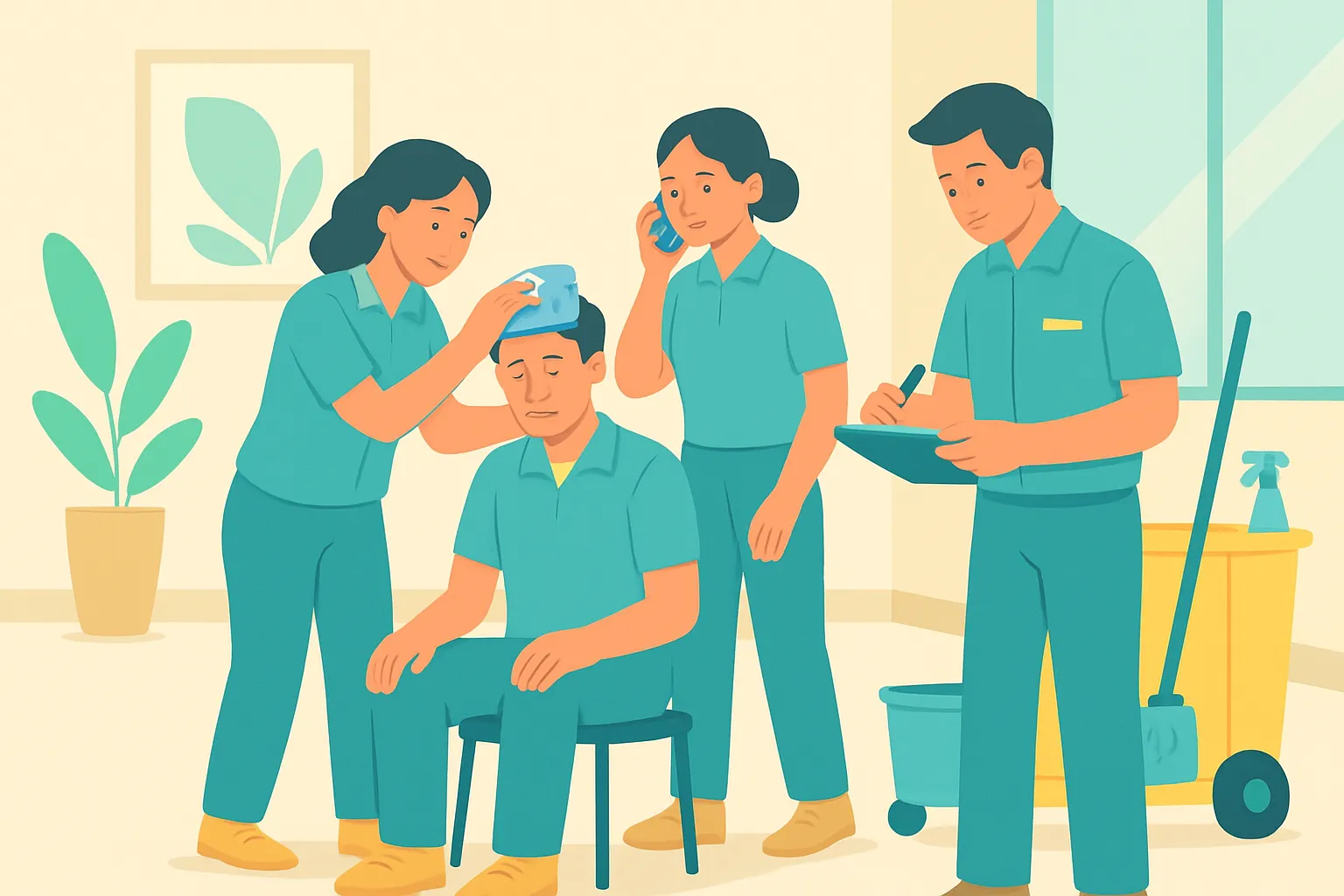
Say you run a three-person residential cleaning crew. Mid-shift, Ana slips on a wet staircase, twists her knee, and can’t put weight on it. What happens next? If Ana is your employee and you carry workers’ compensation, that policy generally pays for her medical care and a portion of lost wages, and it usually shields your business from an employee lawsuit. If she’s a 1099 and truly independent, her own coverage would apply. If you don’t carry required coverage, you could face penalties—and be sued.
This guide shows what to do in the first hours, who pays by worker status, how state rules differ, which insurance responds (and what doesn’t), OSHA reporting, and the documentation and prevention steps that protect your cleaning business.
Key takeaways
- If a cleaner is your employee and you carry workers’ compensation, that policy pays medical bills and part of lost wages and typically serves as the “exclusive remedy” against lawsuits. That’s how workers’ comp is built to work. Insurance Information Institute.
- If you classify cleaners as 1099s but direct when, where, and how they work, you may have misclassified them. The IRS uses behavioral, financial, and relationship factors to decide who’s an employee. IRS worker classification.
- Most states require workers’ comp for employees (Texas is the major exception). The NAIC notes Texas allows employers to opt out; opting out can expose you to lawsuits. NAIC workers’ comp overview.
- General liability doesn’t cover injuries to your own employees. That exclusion is standard. III on liability insurance.
- OSHA requires you to report any work‑related in‑patient hospitalization, amputation, or loss of an eye within 24 hours, even if you have 10 or fewer employees. OSHA severe injury reporting. (osha.gov)
What happens right after a cleaner is injured on the job?
- Get medical care now. Call 911 for serious injuries. For non‑emergencies, follow your state’s rules on choosing a treating provider (some states let the employer choose; others let the worker choose). Workers’ comp gets the injured worker prompt care and replaces a portion of lost wages while they’re out.
- Secure and document the scene. Take photos, note hazards (wet floors, damaged ladders), and list witnesses.
- Tell your insurer and start the claim. Workers’ comp carriers generally want immediate notice so they can help coordinate care and file the first notice of injury with the state. (www-legacy.iii.org)
- Consider light duty and return‑to‑work plans if a clinician clears the worker for restricted tasks. Early return‑to‑work often reduces total time away.
Real‑world example: In Ana’s case, you photograph the stairs, note the client mopped the steps before your crew arrived, arrange urgent‑care evaluation, and notify your insurer the same day. That paper trail speeds care and claims.

Who pays if the cleaner is your employee or a 1099?
- Employee (W‑2): Your workers’ compensation policy pays allowed medical costs from the first dollar and a portion of lost wages, and it typically protects you from an employee injury lawsuit—the “exclusive remedy” trade‑off built into state laws. See the Insurance Information Institute explanation.
- Independent contractor (true 1099): There’s no statutory benefit from your policy unless your state requires coverage for certain contractors or you’ve added them to your policy. If they carry their own workers’ comp or occupational accident policy, that coverage may respond. Be careful: some “alternative” policies aren’t workers’ comp and don’t grant lawsuit protection. Texas regulators warn that alternatives bought from unlicensed insurers aren’t workers’ comp and you lose legal protections. Texas Department of Insurance guide.
- Misclassification risk: If you control what, how, and when someone cleans, the IRS may consider them an employee no matter what your contract says. That can leave you liable for retroactive premiums, penalties, and claims costs. See the IRS common‑law employee test.
Hiring subs? Require proof of their own coverage and verify it’s current. For practical steps, see Insuring subcontractors for a cleaning company.
Are you required to carry workers’ comp for cleaners in your state?
Rules vary by state and change over time, but two patterns matter:
- Most states: Workers’ comp is mandatory if you have employees, sometimes even just one. California requires coverage if you have one or more employees. California DWC employer info.
- Texas: Private employers can opt out, but doing so removes exclusive‑remedy protections and exposes you to lawsuits; non‑subscribers also have specific notice and reporting duties. Texas Department of Insurance.
Industry risk also plays a role. BLS data show janitorial services had an injury/illness incidence rate of 2.0 per 100 full‑time workers in 2023; carpet and upholstery cleaners were higher at 4.3. Bureau of Labor Statistics, 2023 industry rates.
If you clean private homes, read Do residential cleaners need workers’ comp?. If you operate in Texas, also see Texas cleaning business insurance requirements.
Which insurance covers cleaner injuries (and what doesn’t)?
Here’s how the core policies stack up for a cleaner hurt on the job.
| Coverage | What it covers | Who it protects | Typical trigger |
|---|---|---|---|
| Workers’ compensation | Medical care for work injuries/illnesses, a portion of lost wages, and death benefits | Injured employee and employer (via exclusive remedy) | Injury arises out of and in the course of employment |
| Employers’ liability (Part Two of workers’ comp) | Lawsuits not covered by statutory workers’ comp benefits (e.g., certain third‑party‑over claims) | Employer | Employee sues outside the comp statute’s benefits |
| General liability | Bodily injury and property damage to third parties (clients, bystanders) | Your business | A non‑employee is injured by your operations; employees are excluded |
| Occupational accident (non‑statutory) | Limited medical/wage benefits defined by policy; not the same as workers’ comp | Typically independent contractors | Work‑related injury for a covered contractor |
| Health insurance | Non‑occupational medical care; most plans exclude on‑the‑job injuries | The insured person | Illness or injury not covered by workers’ comp |
| State disability (select states) | Partial wage replacement for off‑the‑job disabilities | Eligible workers in CA, HI, NJ, NY, RI, PR | Non‑occupational disability; work injuries go to workers’ comp |
Why general liability doesn’t apply: injuries to your own employees are excluded because they’re supposed to be handled by workers’ comp. That exclusion is standard in liability policies. III on liability exclusions.
Employers’ liability (Part Two) helps if, say, a client sues you after an employee injury and then seeks to shift blame back to you (“third‑party over” suit). It’s bundled with workers’ comp but operates outside statutory benefits.
For other exposures cleaners face (e.g., damaging a client’s rug or valuables), see Insurance for carpet cleaning damage claims and What happens if a cleaner breaks a client’s valuables. For guest injuries in rentals, see general liability for short‑term rental cleaners.

OSHA reporting and recordkeeping for small cleaning businesses
- Report severe injuries fast. As of October 2026, OSHA requires all employers to report any work‑related in‑patient hospitalization, amputation, or loss of an eye within 24 hours (fatalities within 8 hours). You must report even if you have 10 or fewer employees. OSHA severe injury reporting.
- Know if you must keep OSHA logs. If your company had 10 or fewer employees at all times last calendar year, you’re generally exempt from keeping OSHA 300/300A/301 logs—but you still must report severe injuries. OSHA 1904.1 small‑employer exemption.
Tip: Even if you’re exempt, keeping an internal incident log helps defend claims, improve safety training, and negotiate insurance.
What to do now: documentation, prevention and a decision checklist
A clean process protects your cleaner and your business.
-
Immediate steps
- Provide or arrange medical care; give the claims contact info if you carry workers’ comp.
- Photograph the area (slippery floors, power cords, chemicals), collect witness names, and write a short incident summary while details are fresh.
- Notify your carrier promptly and cooperate with return‑to‑work planning once the clinician clears restrictions.
-
Prevention basics for cleaning teams
- Train on ladders, slips/trips, and chemical handling. Track completed training.
- Standardize wet‑floor signage, footwear with slip‑resistant soles, and two‑person lifts for heavy items.
- Pre‑job walk‑throughs: assign hazards (pets, cluttered stairs) and controls before work starts.
-
Decision checklist (answer these today)
- Do you have employees on payroll? If yes, do you carry workers’ comp in every state where they work?
- Do any 1099 cleaners really meet the IRS independence tests (behavioral, financial, relationship)? If not, reclassify.
- Do you collect and verify certificates of insurance for any subcontractors?
- Do you have an incident reporting playbook (who calls care, who informs the carrier, how to secure the scene)?
- Do you have a light‑duty list (supply prep, inventory, estimates) to speed return‑to‑work?
- Have you reviewed your broader insurance program in the past 12 months? If not, start with how much cleaning business insurance can cost.
-
Questions to ask your agent
- If a cleaner is injured at a client site, which doctors can they see under our state’s rules?
- What are our employers’ liability (Part Two) limits, and do we need higher limits given our client contracts?
- How are 1099s treated on our current policy? What documentation do you need when we hire subs?
- If we operate in Texas, what changes if we’re a subscriber vs. a non‑subscriber? What notices and filings are required?

Frequently asked questions
Does my cleaner’s personal health insurance cover on‑the‑job injuries?
Typically, no. Work injuries are handled by workers’ compensation. Health policies often exclude work‑related injuries because that risk is intended for workers’ comp. If you don’t carry required workers’ comp, you could face fines and civil suits depending on your state.
What if I’m a solo cleaner with no employees?
Most states don’t require sole proprietors with no employees to buy workers’ comp, but you may be able to opt in for your own wage and medical protection. Requirements and options vary by state; check with your state’s workers’ comp agency or a licensed agent.
How much wage replacement does workers’ comp provide?
It depends on state formulas and the type of disability (temporary vs. permanent; partial vs. total). All states provide medical benefits; income benefits are a percentage of wages up to a cap set by statute.
Are cleaners really at high risk for injuries?
Cleaning work involves slips, trips, ladder falls, lifting, and chemical exposures. Federal data show janitorial services had an injury/illness incidence rate of 2.0 per 100 full‑time workers in 2023; carpet and upholstery cleaning was higher at 4.3.
Do I have to file an OSHA report if my cleaner goes to the ER?
ER visits alone aren’t automatically reportable. OSHA requires reporting within 24 hours for work‑related in‑patient hospitalizations, amputations, or loss of an eye (fatalities within 8 hours). You may still need to record the case on OSHA logs if you’re not size/industry‑exempt.
Bottom line
If a cleaner gets hurt on the job, the fastest, cleanest path is: care first, document thoroughly, and let workers’ comp do what it’s built to do. Confirm your worker classifications, carry workers’ comp wherever it’s required, set up a simple reporting playbook, and train for the hazards cleaners see every day. Those steps cut downtime, protect your crew, and keep a bad day from becoming a business‑ending claim.
Sources
- Insurance Information Instituteiii.org
- IRS worker classificationirs.gov
- NAIC workers’ comp overviewcontent.naic.org
- III on liability insuranceiii.org
- OSHA severe injury reportingosha.gov
- osha.govosha.gov
- www-legacy.iii.orgwww-legacy.iii.org
- Texas Department of Insurance guidetdi.texas.gov
- California DWC employer infodir.ca.gov
- Bureau of Labor Statistics, 2023 industry ratesbls.gov
- OSHA 1904.1 small‑employer exemptionosha.gov

Stephanie Mitchell has 20 years of experience researching and explaining business insurance topics for small business owners. About the author · Editorial standards